

Before the 1950s, we shipped goods in boxes, crates, and sacks. Dock workers would load and unload each item individually.
Then came the shipping container.
Containerization came with huge upfront costs: ships had to be refitted, ports needed new cranes, and processes had to adapt. On the upside, containers drastically reduced loading times and labor. It also standardized transportation of goods: The same container could be loaded onto a truck or train without unpacking. Containerization standardized how goods move. Once everything fit into the same container, the logistics became simpler and faster.
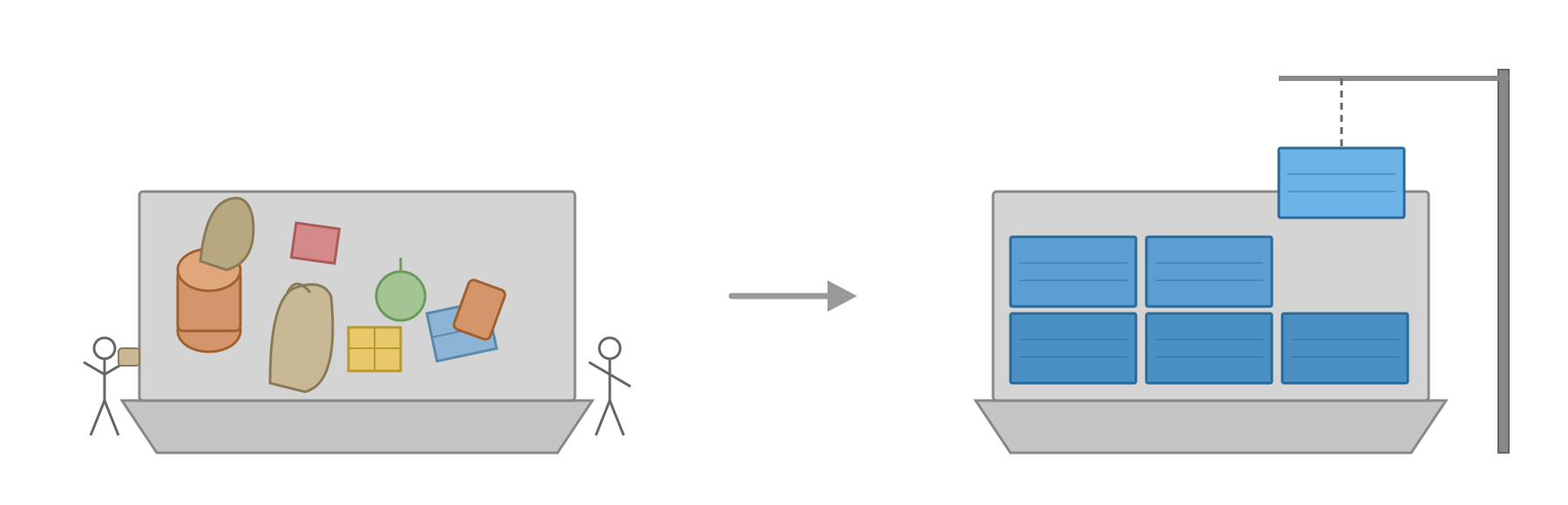
Machine learning has seen a similar kind of standardization. If you wanted to train an image recognition model for dogs in 2005, you’d maybe have applied edge detectors, thresholded intensities, and hand-crafted a feature vector. Then train something like a support vector machine on top. Every problem required its individual solution.
Today, you can start from the same place regardless of the task: a pre-trained foundation model. Take a Vision Transformer, fine-tune it on your data, or train a logistic classifier on the embeddings. And it will likely just work. Wherever you look, you’ll find pre-trained, often transformer-based, foundation models: for translation, image recognition, image segmentation, speech-to-text, text-to-speech, video generation, …
All data modalities and tasks are occupied by foundation models.
All? No! One small modality still holds out against them: tabular data.
But this resistance is crumbling.
TFMs are a fundamental shift, not just a performance trade-off
TabPFN opened the era of foundation models for tabular data. For small and mid-sized data, tabular foundation models now outperform other ML algorithms (see TabArena). I feel like the discussion in the ML community has since switched from “performance not there” to:
“Is a slight increase in performance worth the increased compute?”
“But it doesn’t work for large data!”
“Wow, so much wasted compute when you could just use linear regression / random forest.”
I agree. For many applications, the increased compute time is an obstacle. But for how long will this be the case? Ultimately, I expect advances in hardware, architecture, and inference tricks to fix these concerns.
As a machine learning community, we are very much focused on benchmarks and computational performance. That’s both the strength and the weakness of machine learning. The focus on benchmarks was certainly difficult for me when I started publishing on ML interpretability, but that’s another story.
Purely judging tabular foundation models in terms of performance and compute distracts from the larger shift I believe tabular ML is undergoing. During my deep dive into tabular foundation models, my intuition grew that this is something big. It took me a while to figure out why exactly I think TFMs are a fundamental shift in data science. Why TFMs are not just slightly better-performing but more expensive models.
This post explains why I now believe TFMs are a really big deal.
PFNs are a universal engine for tabular ML
CatBoost, logistic regression, SVMs – the boxes, crates, and sacks of tabular ML – get the job done. Scikit-learn has done a great job of containerizing them at least API-wise with .fit, .predict, …. But underneath, they are very different algorithms, producing very different models. Some thrive on CPU, some on GPU. Very different optimization, failure modes, task-readiness, and so on. You always have to train from scratch, which is especially difficult with smaller datasets. Integrating prior domain knowledge is also inconsistent between ML algorithms. For example, if you suspect your data should have a maximum interaction depth of two, for linear models, you would have to actually add interaction terms, while for tree-based models, you would have to restrict the depth of learned trees.
All of this changes with tabular foundation models, specifically with prior-data fitted networks (PFNs). Pre-trained on millions of synthetic data examples, these transformer-based models are trained to perform in-context learning. Prediction essentially becomes a single forward pass of training and test data at once, and – without changing the weights – the model predicts the test data by attending to the training data.
To keep with the analogy of shipping, we finally have a general-purpose container for tabular machine learning, or even for data science more generally. The general purpose technology enabling this containerization is the prior-data fitted networks. Read my post about PFNs here. PFNs are a general method of essentially self-supervised learning that consists of creating synthetic (tabular) tasks, on which a (transformer-based) model is pre-trained to predict new data via in-context learning. Thanks to PFNs, we now have tabular foundation models that can do classification and regression without needing to be trained on the particular task at hand.
If classification and regression were the only applications, I probably wouldn’t call it a revolution. While these two tasks already make up a substantial portion of business and research tasks, tabular ML and data science are much larger. For TFMs, classification and regression were the first milestones to be taken seriously by the ML community.
But TFMs are not stopping there. Any data science task that you can express as a self-supervised learning problem (including a data generator) can be learned by the PFN “engine” to pre-train a TFM that then one-shots this task.
Let’s have a look at the implications.
If you can simulate it, you can pre-train for it
Off-the-shelf classification and regression TFMs already work for survival analysis and time series forecasting. That’s impressive and relevant, but not the paradigm shift I’m talking about. The big shift comes from being able to pre-train tabular foundation models for ANY data science problem for which we are able to simulate data with a ground truth. Researchers have already begun pre-training foundation models for other tasks:
Time-series forecasting: TimePFN
Anomaly Detection: FoMo-0D
Classification and regression for graphs: GraphPFN.
p>n prediction problems (like genomics): TabPFN-Wide
Missing data imputation: TabImpute
Clustering: TabClustPFN.
Counterfactual fairness: FairPFN
Estimate Shapley values: ExplainerPFN
Bayesian Optimization surrogate model: PFNs4BO
This non-exhaustive list shows how versatile the PFN-engine is to pre-train tabular foundation models beyond classification and regression. Pre-training a TFM is not a small feat, especially since designing the prior, aka the data distribution, is not always easy. But once pre-trained, you can use it on any table for that same task. I expect this list to become even larger while also niching down into more specific use cases.
The PFN-engine also allows you to instill any inductive bias into the model that you can define via the prior. For example, you can robustify TFMs through adversarial training. Or, to absorb useful inductive biases from tree-based models, you can add tree-based relationships into the prior (see also this paper). This all comes on top of PFNs already being able to adapt to inductive biases through in-context learning alone, as research suggests.
And since they are so versatile and predict the entire posterior predictive distribution, not just a point estimate, TFMs can also be used for density estimation and synthetic data generation. Both are already built into TabPFN and would also be doable with other TFMs.
All these facts and developments show how much of a general-purpose technology PFNs are: There will be TFMs for every suitable data science problem soon.
Tabular ML now rides the deep learning wave
The non-tabular machine learning world has already converged on deep neural networks, and many even on transformer-based foundation models. Tabular is, or rather, was the last bastion to hold onto its boxes, crates, and sacks. The only modality not using the same “container” that the other modalities are using.
By switching over to tabular foundation models, we are essentially streamlining tabular with the other modalities. I liken technical developments to a river. The huge investments and talent in deep learning/transformers make this a very strong river. Tabular is now dipping into this flow, and the transformer river is carrying tabular with it. Suddenly, tabular ML also benefits from the vast ecosystem:
Investments in GPU infrastructure now benefit tabular.
Any further, more specific hardware for neural network training/inference makes tabular ML more efficient.
Race to make LLM inference cheap also helps TFMs.
Architectures (e.g., attention mechanisms) are getting better.
All the optimizations and learnings for training and deploying LLMs, like LoRA, quantization, and Muon, may be transferred.
We can build with very mature and user-friendly deep learning software like PyTorch (I still remember what a pain TensorFlow was in 2018).
Tabular data now becomes more interesting to a large pool of AI investors.
All these developments carry tabular foundation models, but not SVMs or boosted trees. TFMs make tabular data science snap into the broader ecosystem.
Besides being carried, there’s improved interoperability with other modalities: TFMs give us embeddings for tabular data, making it straightforward to represent and reuse tables. For example, it has now become easier to train multi-modal models with tabular data as a modality.
I’m betting on foundation models
It’s been some time since I’ve been this excited about tabular ML. Tabular foundation models feel like the first refreshing change in a long time. I just don’t care about yet another algorithm that produces a tree ensemble.
Given my reasoning above (containerization), I’m personally betting on TFMs. (“Betting” as in investing my time and attention, not as in participating in prediction markets.) I am planning to learn more about them, to push them forward, and to educate. For example, I started working on TFM overview, a website that tracks libraries and labs.
I love your posts (and books!), thanks for sharing. Is this going to be a series on TFM?
I have never stopped being excited about tabular ml, we played around with some of these models on kaggle already a few years ago.
I don't know if I remember correctly but back then they were insanely performant but super expensive (slow) to train comparative to an ensemble that with a bit of tweaking could get the same results or better.
It was easier of some sort to get a good result, though not necessarily faster in actual time.
Do you think we'll have some sort of tabular foundation model that will solve any problem better than any our "traditional" algos?
What I liked about some of these were that they also came with metrics that lets you inspect which features were used the most and interactions etc, which can be used as insight.
Very interesting article, but has an "end of history" kind of vibe to it... we can not imagine what the future will bring. For my taste the article sounds to sure of itself. Even though I learned a lot about foundation models and the and linked models seem super interesting!